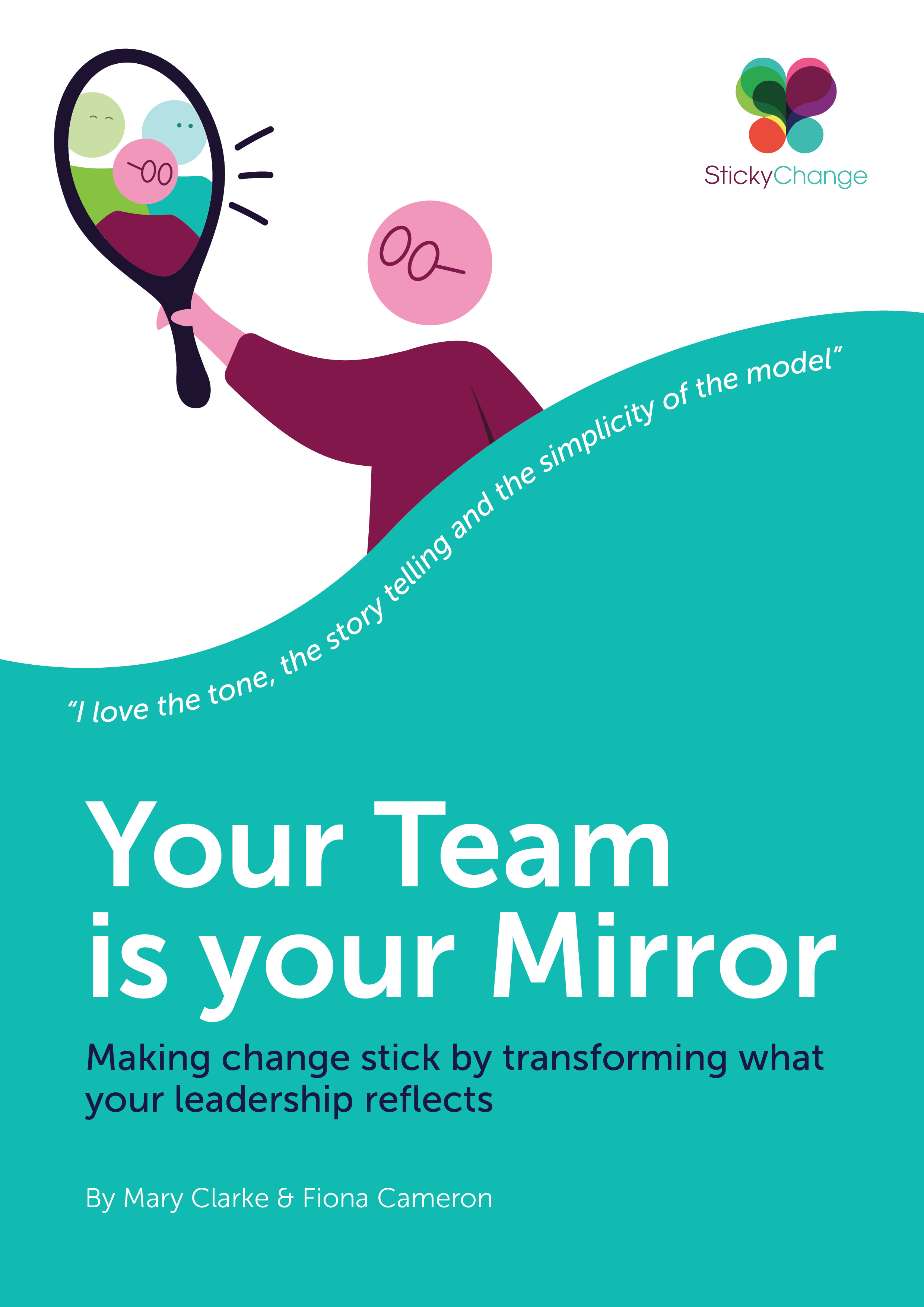
Your Team is Your Mirror
For leaders leading culture change

Your Team Understands the Change. So Why Aren't They Getting Behind It? 
The answer might be looking back at you in the mirror.

After 30+ years working with leaders and teams, we've seen good change programmes stall despite the best plans. Often, it's not what leaders say that makes the difference, but how people experience their behaviour. And that's something every leader has the power to change.

Yes! Rush me a copy for $20
Ebook only · Instant download

When the programme looks on track and nothing has changed

It's a Monday morning change programme update. The usual discussion points: workstreams, governance, a communication plan, a RAG report that has said amber for the last 8 months. Anyone who wandered in for ten minutes would think it was going well.

But when the meeting ends, the leader chairing it admits what has been bothering them for months. People attend the sessions and say the right things. Nobody challenges anybody. Ownership rises when the senior team is in the room and then fades away when they leave. And the engagement scores have just confirmed it.  The change is not having the impact they want.

You may have said some version of this yourself:

"I don't understand. We've been completely clear about why we're doing this."

"They agreed in the meeting. So why is nothing changing?"

"We just need to communicate better."

If this sounds familiar, you're not alone, and you're not broken. You've done what you were trained to do, you've followed all the best practices. However, there may be a difference in what you intend people to experience and what they actually experience. 
Why explaining the change even more clearly won't get people on board

A common belief goes like this: if the logic is sound, the plan is clear and the message is repeated often enough, people will come with you. When they don't, you explain it again and again.

It's a reasonable belief. Organisations reward rational thinking, board papers assume a tidy, organised world and a plan makes change feel manageable. Mary and Fiona call this belief the 'Rational Change Illusion'.

It's dangerous because it isn't entirely wrong. People usually do understand the case for change and can even repeat the logic back to you. However, they worry about their future, they grieve over the loss of how things have 'always' been and/or they watch you closely to see whether this change is here to stick or will vanish when the next urgent thing arrives.  In their experience, they just need to keep their heads down and it will go away.

People rarely struggle to understand change. It's how they feel about it that shapes their response, and leaders have a powerful influence on those feelings.

Why standard change models and another town hall won't fix this

Established change models such as Kotter’s Eight Steps, Lewin’s Force Field Analysis and ADKAR, provide highly valuable frameworks for managing change. But managing the process is only part of the picture. These models tell us far less about how people actually experience change, and how those feelings shape their response to it.

ADKAR can tell you someone's desire is low. It can't tell you why. The why is nearly always emotional and it nearly always involves what that person is experiencing from the leaders asking them to change.

There's a second problem: the more senior you get, the less honest feedback you receive, particularly about how people are feeling. The book calls this the feedback desert. This isn't because you are surrounded by yes-people, rather you're surrounded by thoughtful colleagues who have learned what is worth raising and what isn't. So the information you're using to judge progress has been edited before it reaches you.

Put those together and you get leaders who mistake silence for agreement and compliance for commitment. They read resistance as a people problem whilst their own behaviour could be reinforcing the very culture they're trying to change.

Why we wrote this book

We've worked together for more than twenty years, helping leaders and teams through change. But we kept watching good programmes stall, not because of a lack of a good plan but because of the messy reality of working with humans!

One engineering company asked us to run employee focus groups around a culture change. People were sceptical,  "Nothing ever changes around here" came up so often it was hard to ignore. Eventually they spoke honestly about leaders saying one thing and doing another. The feedback was painful such that the leadership team lost motivation, meetings got less frequent and the change initiative faded away! Their people's prediction came true, and the cynicism was even deeper afterwards.

Because you can't talk a team into a culture change you aren't demonstrating yourself. After years helping organisations navigate change, we've learned that even the best plans and clearest messages can fall flat. Because people don't just listen to what leaders say. They watch what they do. And when the two don't match, behaviour wins.

That's where the book came from. The leaders we saw make progress rarely had the cleverest plan. They were the ones willing to get curious about the distance between what they meant and what their people felt.  About what their people were experiencing and their part in it.  About what their teams' behaviour said about them as leaders.

Why changing how you lead works when more communication or a better plan doesn't

When you start looking in the mirror and treating your team's behaviour as information about your leadership, the behaviours that have frustrated you start to make sense, and you can do something about them.

Teams adapt to what you reward, what you tolerate, what feels safe and what feels risky. A team that stays quiet may have learned that speaking up doesn't pay. A team that keeps asking for clarity may be responding to priorities that change faster than anyone can absorb. A team that works around a new process may be telling you it doesn't work in real life.

One Sales Director spent a weekend redoing his team's presentation for the company owner, frustrated at its quality. Then, after being challenged in a coaching session, he realised he'd never told them the owner was highly detailed conscious. His briefing had failed, his team hadn't. 

The mirror doesn't judge. It shows you what people are absorbing from you, and that gives you something you can change today.

The MIRROR Model: a six-step plan for culture change that lasts

It starts with what your leadership is producing in the people around you, then builds the trust, safety and shared ownership that make change last after the programme ends. Each step creates the conditions for the next.

01
Make the Mirror visible
Treat silence, workarounds and polite nodding as information about how your leadership is being experienced.
02
Identify the illusion
Notice where you've leaned on logic, plans and messaging and find out how the change is landing emotionally.
03
Rewire how you show up
Choose one specific behaviour to practise differently and ask your team to help you notice it.
04
Repetition, repetition, repetition
Keep the new behaviour going even when under pressure, because that's when your team decides whether it's real.
05
Own the change together
Move from doing change to people to doing it with them, so it becomes theirs.
06
Reinforce what sticks
Build habits and rhythms that carry on when you're no longer in the room.
Get your copy and start with step one this week. $20
Ebook only · Instant download

What Others Are Saying

"It's an easy to read, relatable book with lots of opportunity for reflection. As someone that struggles to read full leadership books, I found it highly engaging."

— Ali Crowley, Chief People Officer, TwinStream

"I love the tone, the story telling and the simplicity of the model. It encourages a dialogue and a positive review on a tough topic."

— Bridget olde Olthof, Former CHRO, Zentiva Pharmaceuticals

"It makes you really think about how your own behaviour is reflected back through your team. The MIRROR model is a simple way of looking at your role as a leader and the impact you have."

— Janine Clements, Commercial Lead, Defence and Manufacturing Company

How one COO got his team to bring him problems early

One of the stories in the book is about Richard, the COO of a specialist food manufacturer. By his own later admission he was a nightmare to work for. His team held kitchen conversations to decide whose turn it was to tell him bad news.

Through coaching and the Mirror Model, he saw that what felt to him like urgency was landing on his team as threat. He practised catching his reaction in the half-second before it showed. Some weeks it worked, and some weeks it didn't. Nine months in, he said the hardest part was tolerating the discomfort of staying calm.

Then the ERP integration came in ahead of schedule, with no escalations. Problems were reaching him early, while they were still small. Engagement in his division moved up from the bottom quartile. The anonymous comment that meant most to him said people now felt they worked with their leader rather than for him.

More From Readers

“I found the reading recommendations highly valuable and the case studies very relevant.”

— Avril Scott, Chief Human Resources Officer, Kantar

“It doesn't read like a traditional leadership or change management book. It feels practical, human and grounded in real-world leadership challenges, rather than theory for theory's sake.”

— Byron Clarke, Director of Global Operations, Halton Group

“What I found valuable are the practical suggestions at the end of each chapter, which translate thinking into genuine behavioural shifts.”

— Jon Moore, Group Financial Controller, Premier League Football Club
Yes! Rush me a copy for $20
Instant download

What You'll Discover Inside

Throughout the book we draw on a wide range of experts, share case studies from real leaders, and offer practical actions to try at the end of each chapter.

01
Why people agree with your change and still don't act on it
The Rational Change Illusion explained, and how to spot when you're leading mostly through logic.
02
The one question that changed things for every leader in the book
It's short, it's uncomfortable, and it starts with "What does this change look or feel like from where your team sits"
03
How to tell if your programme looks on track but isn't working
Spotting obvious failure is easy. This chapter shows you how to catch the subtler kind.
04
Why a quiet team may not be a disengaged one
A practical exercise for rewriting the explanation you've been carrying about your team's most frustrating behaviour.
05
Four things that stop senior leaders looking honestly at themselves
These include the feedback desert and the belief that showing doubt costs you authority.
06
What to do in the first ten seconds after someone criticises you
Includes the five words to say instead of defending yourself, and why your face matters as much as your words.
07
How an HR Director found out her team rated their safety to disagree at four out of ten
She expected eight, the one behaviour she changed is in Chapter 7.
08
Seven ways to show up differently once you've seen the problem
They're arranged under the word REFLECT, from recognising your part to taking the lead yourself.
09
How to stop being the person every decision runs through
Chiara's three questions, and why her team probably felt the vending machine had broken at first.
10
A short way to measure how safe your team feels
How to use Amy Edmondson's seven statements to measure Psychological Safety.

Is This Right For You?

This is NOT for those who:
  • Want a 70,000-word thesis on change management. The authors say plainly this isn't one.
  • Believe resistance is always a people problem and would like a book confirming it.
  • Plan to hand "the culture piece" to HR and get back to the P&L.
  • Are looking for a new model to put on a slide and never practise.
This is for:
  • Leaders responsible for change who care about their people and are tired of programmes that tick every box and shift very little.
  • Leaders who've done the strategy days and the leadership courses.
  • Leaders willing to consider that their team's behaviour might be telling them something about themselves, and who'd rather know than keep guessing.
Get your copy of Your Team is Your Mirror now. $20
Ebook only · Instant download

Frequently Asked Questions

Is this just another change management book?
No. It deals with the part most change models leave out: how people experience their leaders while the change is happening and how their emotions can get in the way. Readers keep saying it doesn't read like a traditional leadership book.
I don't have much time. Do I need to read all of it?
The authors suggest that if you're short of time, read the Introduction, Chapter 3 on the Rational Change Illusion and Chapter 4 on the MIRROR Model. Then pick one suggestion that fits and practise it.
Do I have to do everything in the book?
Please don't. Mary and Fiona would rather you practised one idea consistently than tried twenty and dropped them all by Friday afternoon. Every chapter ends with a short "Try this" so you can choose.
What if my team won't be honest with me?
That's common at senior level, and the book expects it. It shows you how to ask in ways people can answer, including anonymous options, and what to do so the honesty keeps coming.
My team is already fairly good. Is this still useful?
Yes. One story is about a finance director who nearly didn't apply for the interim CEO role. Her mirror showed her strengths she'd spent years dismissing. If you already lead this way, the book will confirm what you do well and help you pass it on.
Is this only for people with "change" in their job title?
No. It's for anyone leading people through change, from CEOs and HR Directors to the head of a single team.
Mary Clarke and Fiona Cameron

Mary Clarke and Fiona Cameron.

Mary Clarke and Fiona Cameron have worked together for more than twenty years through their company, Sticky Change, coaching leaders and facilitating teams through change. The leaders in this book are their clients, with details changed to protect privacy.

They've been on the wrong side of the mirror themselves. Writing the book meant asking reviewers for honest feedback and taking it, and it made them look again at the impact they have on each other. Their aim is simple. They want leaders to see the gap between what they intend and what their people experience, and to have a practical way to close it.

Your Team Understands the Change. So Why Aren't They Getting Behind It?
The answer might be looking back at you in the mirror.

After 30+ years working with leaders and teams, we've seen good change programmes stall despite the best plans. Often, it's not what leaders say that makes the difference, but how people experience their behaviour. And that's something every leader has the power to change.

Buy the book — $20
30-day refund · Ebook only · Instant download